Roma 2023_Concorso internazionale per il nuovo Museo della Scienza di Roma
Dopo un lungo percorso decennale, il Comune di Roma nel 2022 bandisce il concorso per il nuovo Museo della Scienza della Capitale, per mettere a sistema la costellazione di istituzioni pubbliche dedicate alla conservazione e divulgazione di tutte le discipline scientifiche, dalla Fisica all’Antropologia.
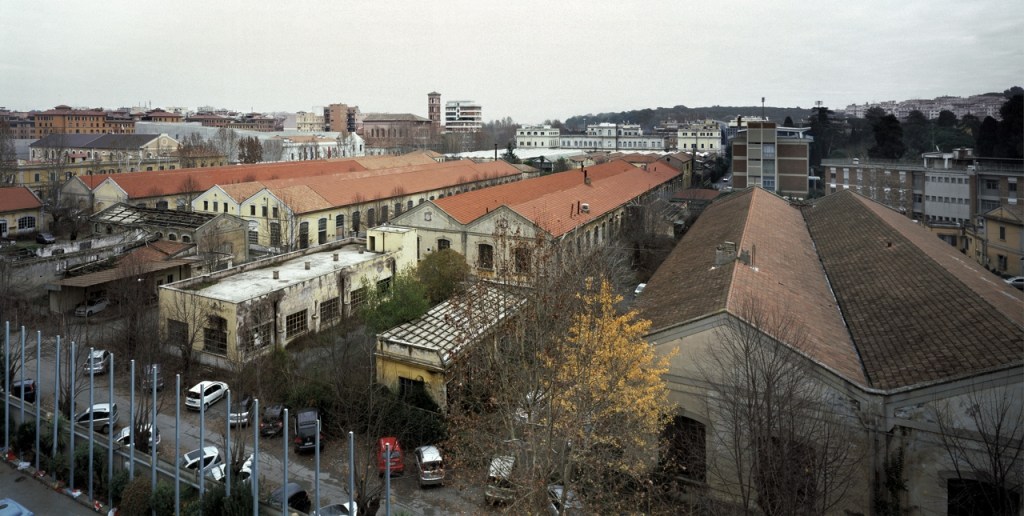
Richiesti 20.000 m2 di spazi espositivi su un’area di 10.000 nel comparto dell’ ex Stabilimento Militare di Materiali Elettronici e di Precisione di Via Guido Reni, delle belle strutture in muratura e ferro dei primi del 900.
La giuria è presieduta da Daniel Libeskind.
After a long ten-year journey, in 2022 the Municipality of Rome announces the competition for the new Science Museum of the Capital, to systematize the constellation of public institutions dedicated to the conservation and dissemination of all scientific disciplines, from Physics to Anthropology.
Requested 20,000 sqm of exhibition space on an area of 10,000 in the sector of the former Military Establishment of Electronic and Precision Materials in Via Guido Reni, beautiful masonry and iron structures from the early 1900s.
The jury is chaired by Daniel Libeskind.
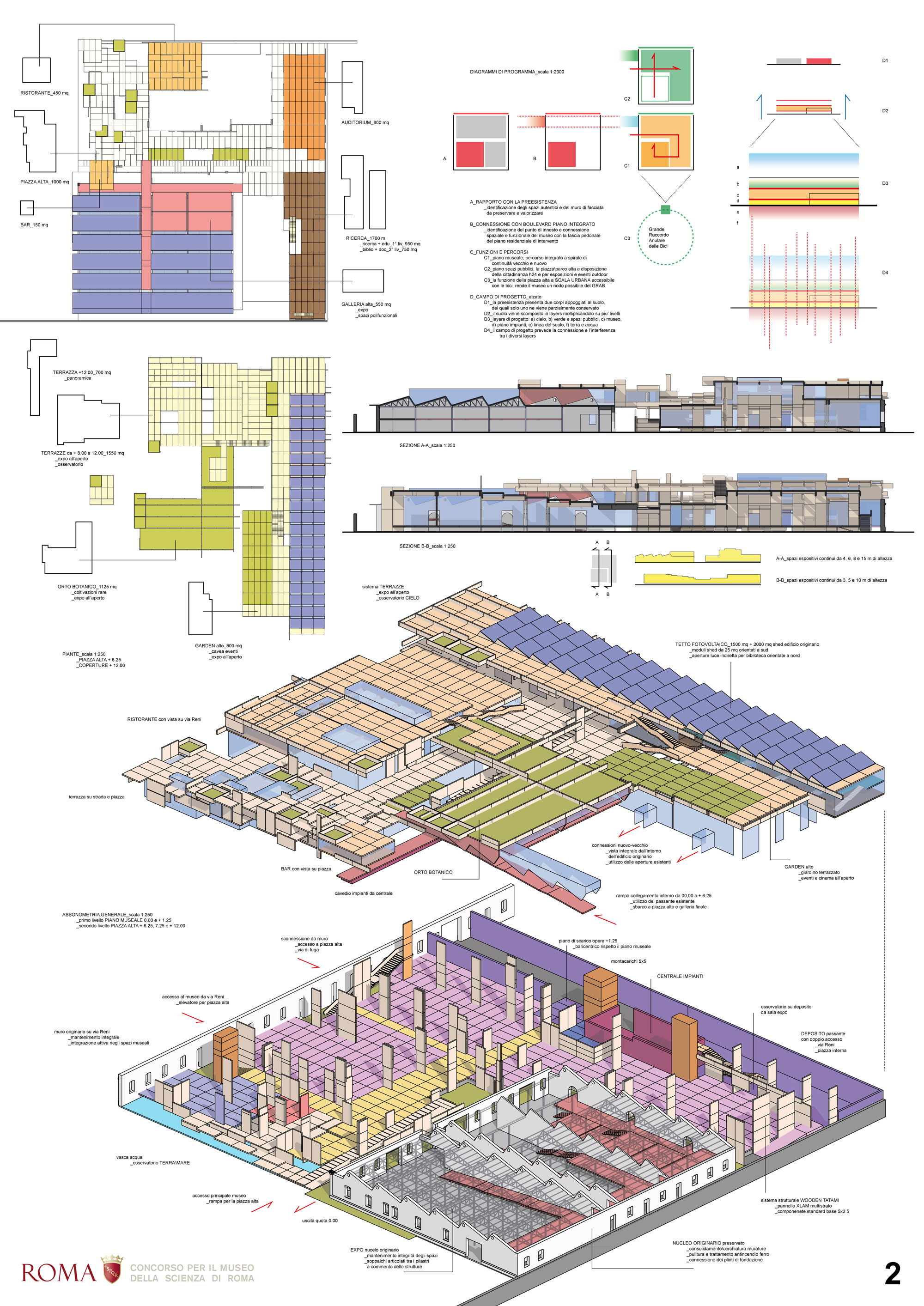
La proposta, arrivata 7^ dopo i cinque finalisti su 70 gruppi internazionali, si sviluppa come una piastra bassa su solo due livelli, uno inferiore museale, uno superiore con una piazza alta accessibile aperta alla città, alle bici e e ogni forma di pedonalità.
Viene conservato un quarto delle preesistenze novecentesche coperte a shed, quelle rimaste integre e autentiche nel corso degli anni, e il muro perimetrale di 100 metri lungo via Guido Reni.
The proposal, which arrived 7th after the five finalists out of 70 international groups, develops as a low plate on only two levels, a lower museum level, an upper one with an accessible upper square open to the city, bicycles and all forms of pedestrian traffic.
A quarter of the pre-existing twentieth-century shed-covered structures, those that have remained intact and authentic over the years, and the 100-metre perimeter wall along Via Guido Reni are preserved.

L’edificio è concepito come una opera aperta estendibile e modificabile nel tempo, realizzato interamente con un innovativo sistema costruttivo modulare in legno Xlam, di rapido assemblaggio a secco e riciclo al 100%.
Scompare il concetto di copertura, sostituita da un grande spazio pubblico raggiungibile con una rampa pedonale completamente piantumato e coltivato con orti botanici alternati a spazi evento ed expo all’aperto.
The building is conceived as an open work that can be extended and changed over time, made entirely with an innovative modular construction system in Xlam wood, quick dry assembly and 100% recycled.
The concept of roofing disappears, replaced by a large public space reached by a pedestrian ramp completely planted and cultivated with botanical gardens alternating with open-air event and expo spaces.

Nella pianta d’ingresso, è visibile l’innesto con la preesistenza novecentesca, la matrice del sistema costruttivo in legno e il sistema distributivo e conservativo anulare, particolarmente importate per il museo dei musei della scienza di Roma, che richiede rotazioni espositive e adattamenti continui.
La geometria neoplastica dell’edificio si contrappone nei due prospetti pubblici alla compattezza delle murature conservate, completando la volumetria in maniera proporzionata al contesto, ma dichiarandosi autonomo per materia e luci-ombre proprie.
In the entrance plan, the graft with the twentieth-century pre-existence is visible, the matrix of the wooden construction system and the annular distribution and conservation system, particularly important for the museum of science museums in Rome, which requires exhibition rotations and continuous adaptations .
The neoplastic geometry of the building contrasts in the two public elevations with the compactness of the preserved walls, completing the volume in a manner proportionate to the context, but declaring itself autonomous in terms of its own material and light-shadows.


Lo spazio pubblico della piazza alta è una funzione nuova rispetto ai requisiti di bando, ottenuta a costo zero con il semplice riuso delle coperture, che divengono dei veri spazi attivi.
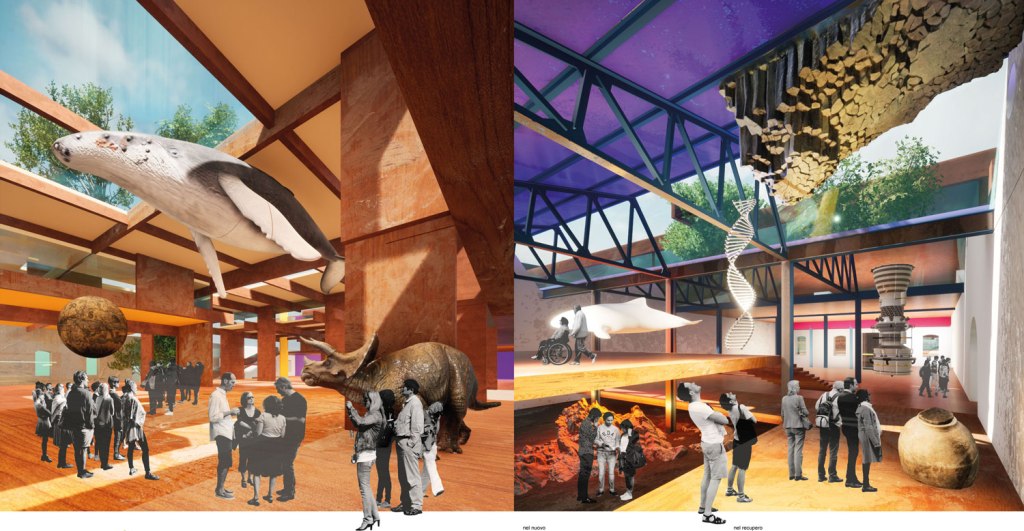
L’esposizione interna inferiore, viene osservata in questa maniera anche dall’esterno, da diversi punti di vista, e continuata all’aperto per tutto il corso dell’anno.
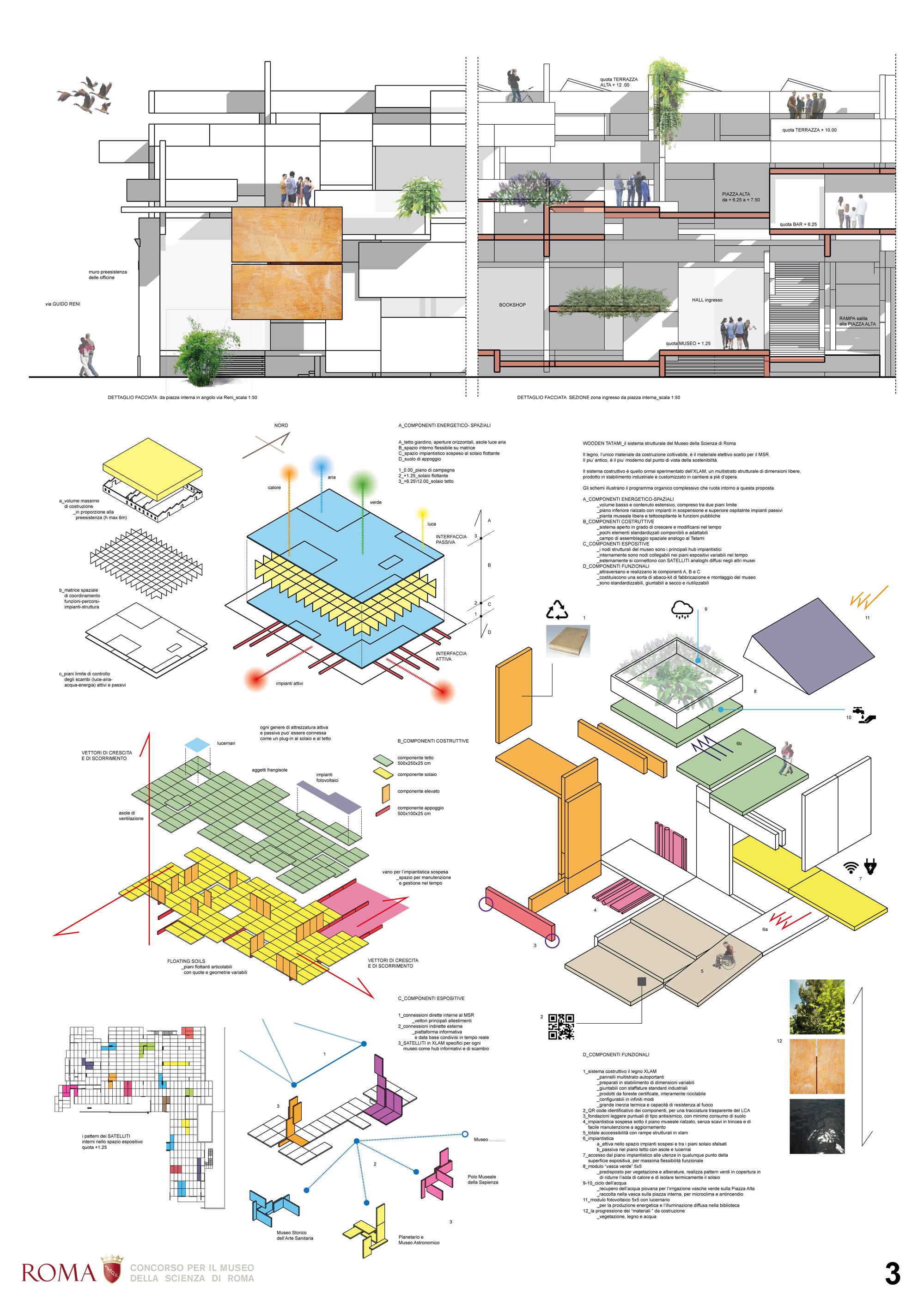
Gli spazi espositivi sono sostanzialmente aperti e definiti solo dai totem strutturali di legno, per consentire ogni possibile flessibilità e articolazione nel tempo.
The public space of the upper square is a new function with respect to the tender requirements, obtained at no cost with the simple reuse of the roofs, which become real active spaces.
The lower internal exposure is also observed in this way from the outside, from different points of view, and continued outdoors throughout the course of the year.
The exhibition spaces are substantially open and defined only by the structural wooden totems, to allow for every possible flexibility and articulation over time.
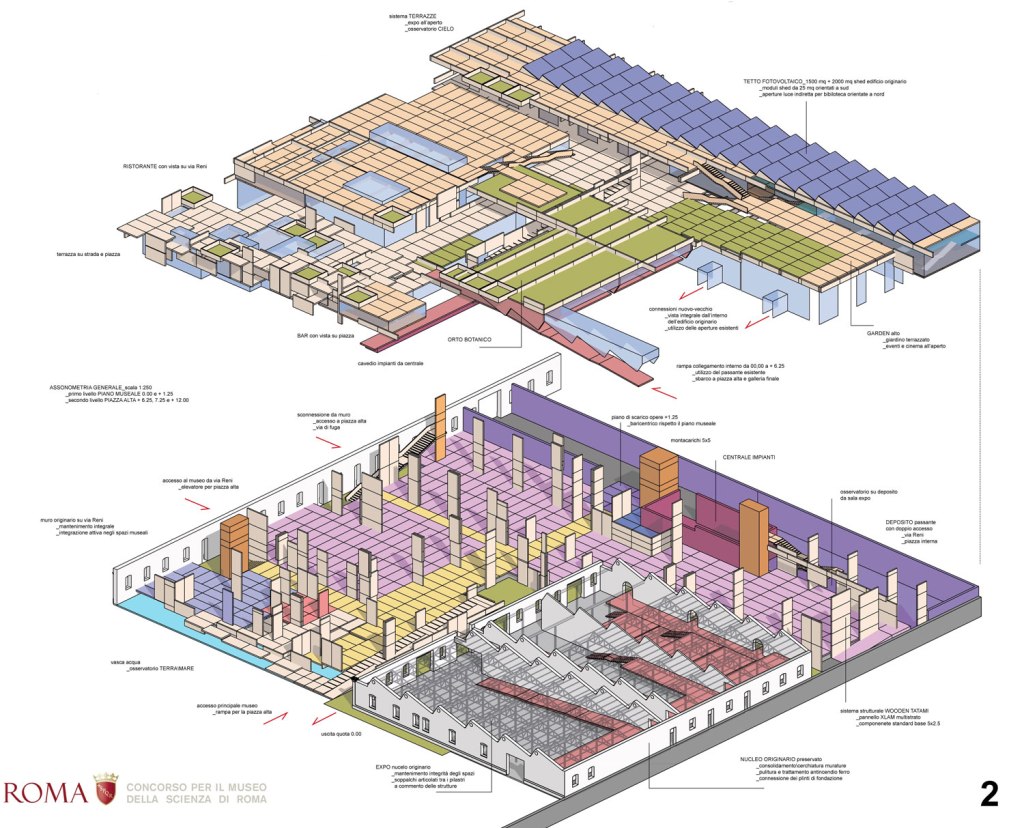
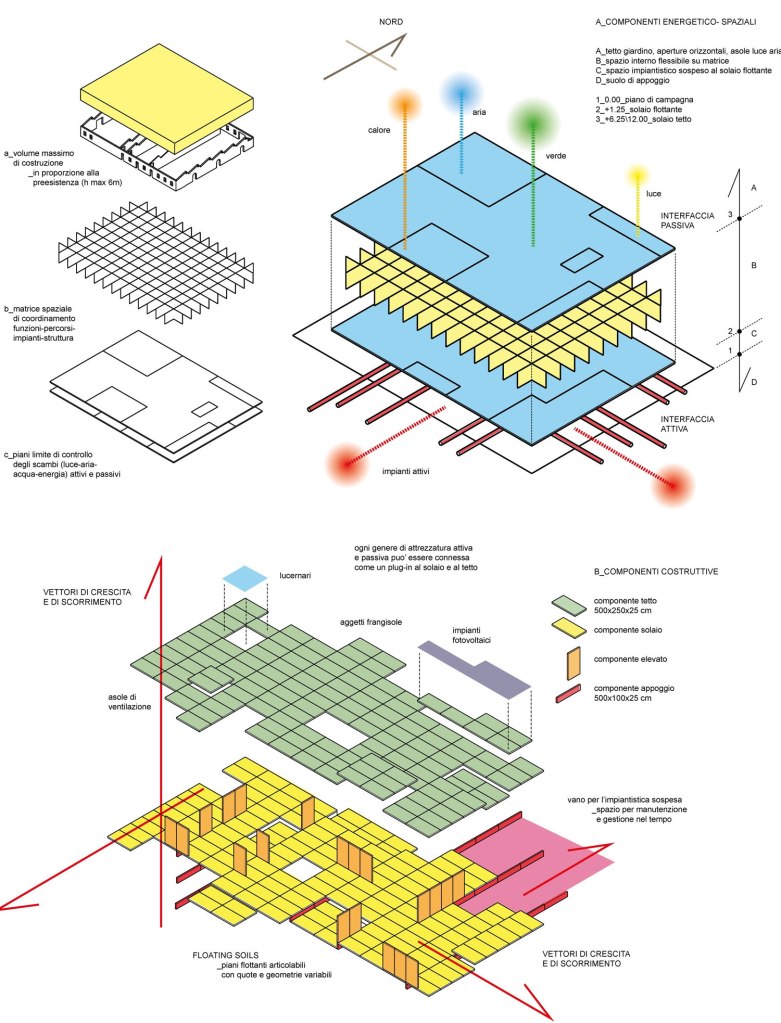
Il sistema Wooden Tatami è in effetti lo sviluppo del concetto orientale di spazio costruito da un elemento base ripetuto in ogni direzione nello spazio per multipli e sottomultipli, in questo caso un semplice pannello strutturale multistrato portante di 5×2.5×0.3 m, assemblato a secco.
Il pavimento rialzato di un metro da terra consente la tessitura e l’adattamento del sistema impiantistico, evitando di effettuare scavi profondi con consumo di suolo.
Il sistema costruttivo comprende anche vasche per giardini pensili, shed fotovoltaici e fondazioni puntuali con dissipatori sismici, congruenti alla grande flessibilità ed elasticità della fibra di legno.
The Wooden Tatami system is in fact the development of the oriental concept of space built from a basic element repeated in every direction in space by multiples and submultiples, in this case a simple 5×2.5×0.3 m load-bearing multilayer structural panel, dry assembled .
The floor raised one meter from the ground allows for the weaving and adaptation of the plant system, avoiding the need to carry out deep excavations with soil consumption.
The construction system also includes tanks for hanging gardens, photovoltaic sheds and punctual foundations with seismic dissipators, congruent with the great flexibility and elasticity of the wood fibre.
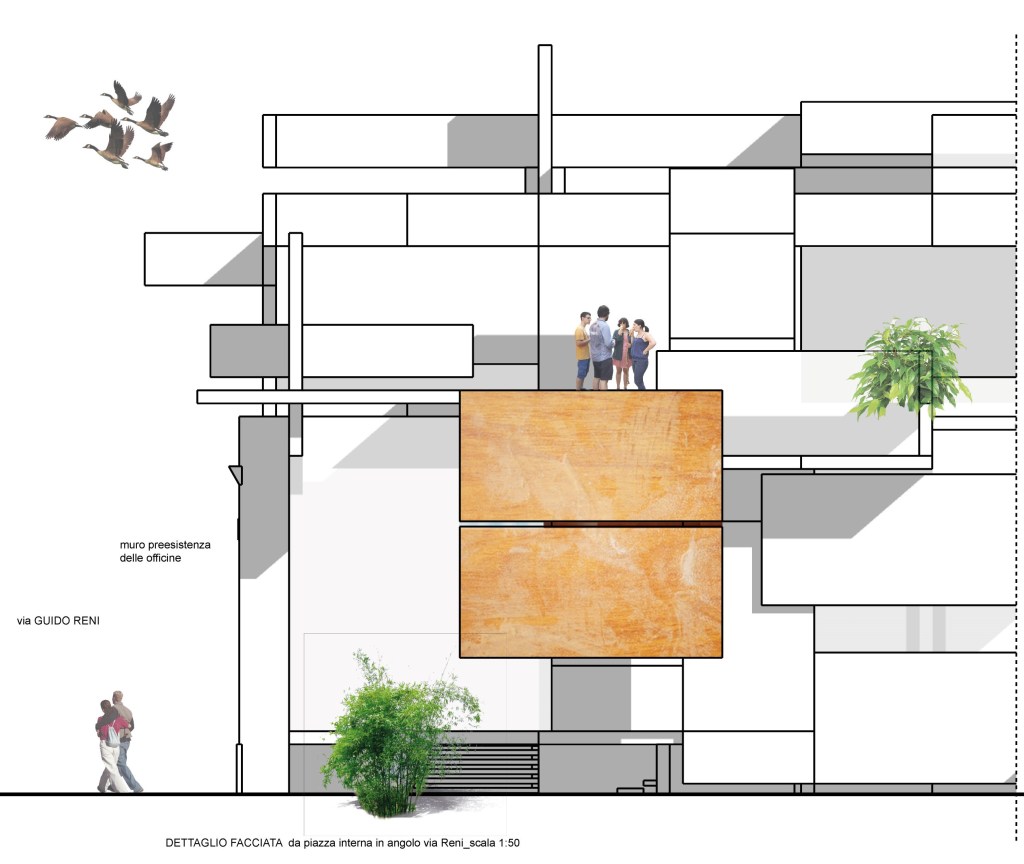

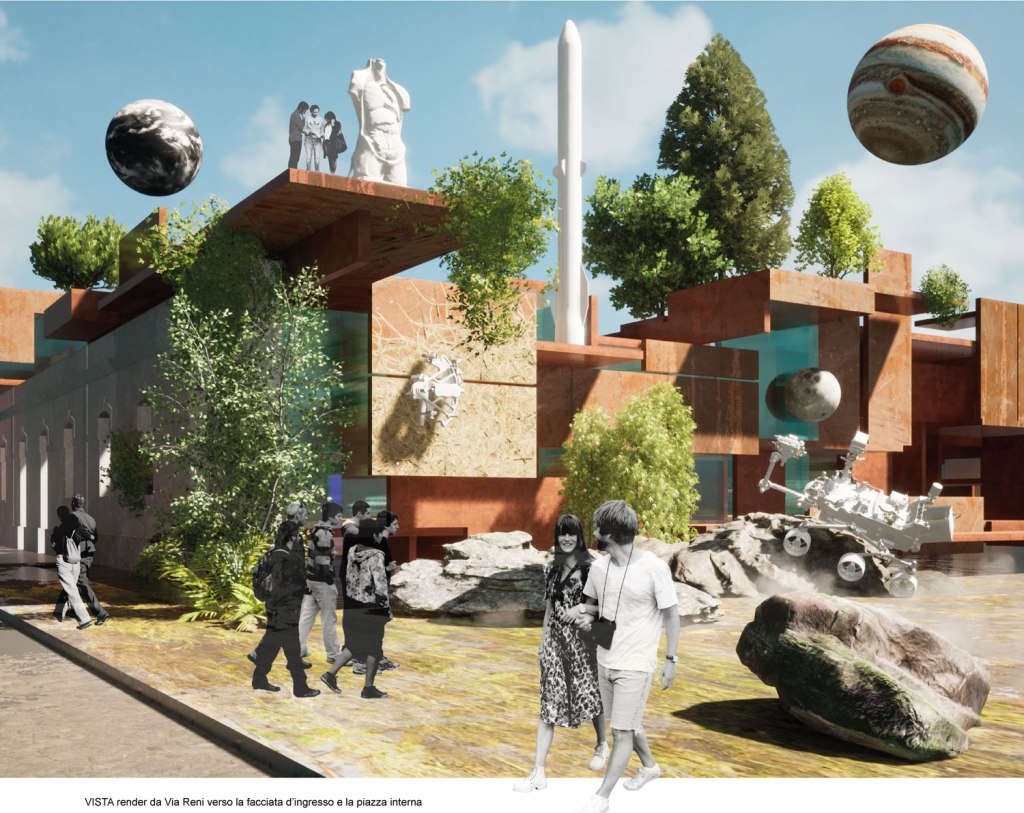
Il wooden museum è una grande bacheca urbana a basso consumo di suolo, sul quale vengono esposti a rotazione molti degli oggetti conservati, in un coro multidisciplinare che non rinuncia al dialogo con la città.
Dal precheck dei crediti LEED, per le sue caratteristiche di recupero del demolito, dell’uso del legno riciclabile al 100%, del posizionamento e tipologia impiantistica, della ricostituzione dei suoli drenanti a zero isola di calore sulla copertura, della produzione locale di energia elettrica rinnovabile, è risultato potenzialmente un edificio con targa Platinum.
The wooden museum is a large urban showcase with low land consumption, on which many of the preserved objects are displayed in rotation, in a multidisciplinary chorus that does not give up dialogue with the city.
From the LEED credits precheck, due to its characteristics of recovering the demolished material, the use of 100% recyclable wood, the positioning and type of plant, the reconstruction of draining soils with zero heat island on the roof, the local production of renewable electricity, it was potentially a Platinum plate building.
 pan_architectures